Deep Reinforcement Learning To Improve Gait Adaptation
 People learn new optimal gaits when adapting to new conditions
Introduction
People learn new optimal gaits when adapting to new conditions. In these adaptations, they rapidly transition between a wide range of speeds or step lengths without falling. In this study, we aimed to determine whether reinforcement learning (RL) can enhance the performance of a pre-trained neural network control policy in adapting a walking model to a wide range of gaits.
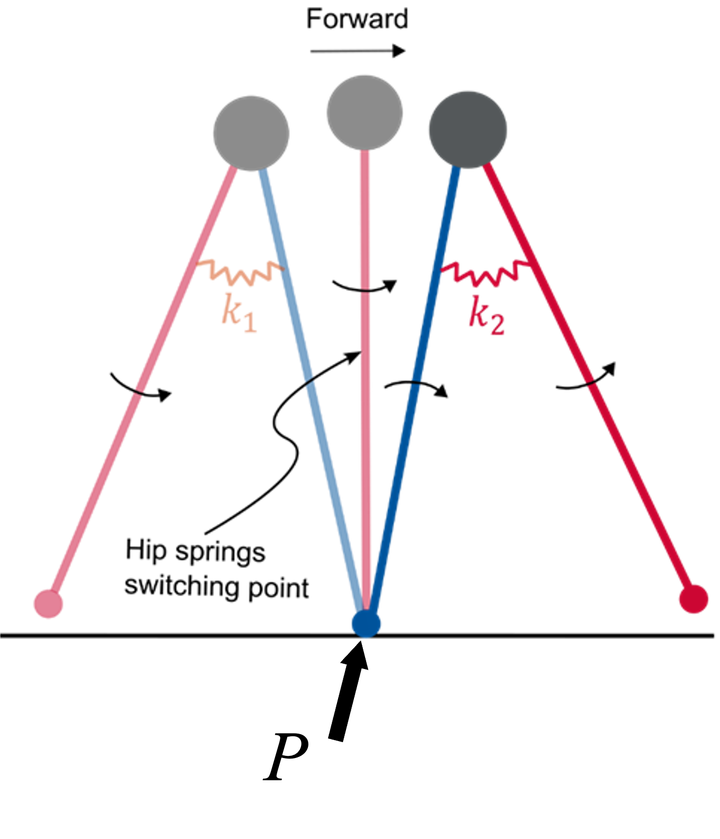
We used a physics-based model of walking
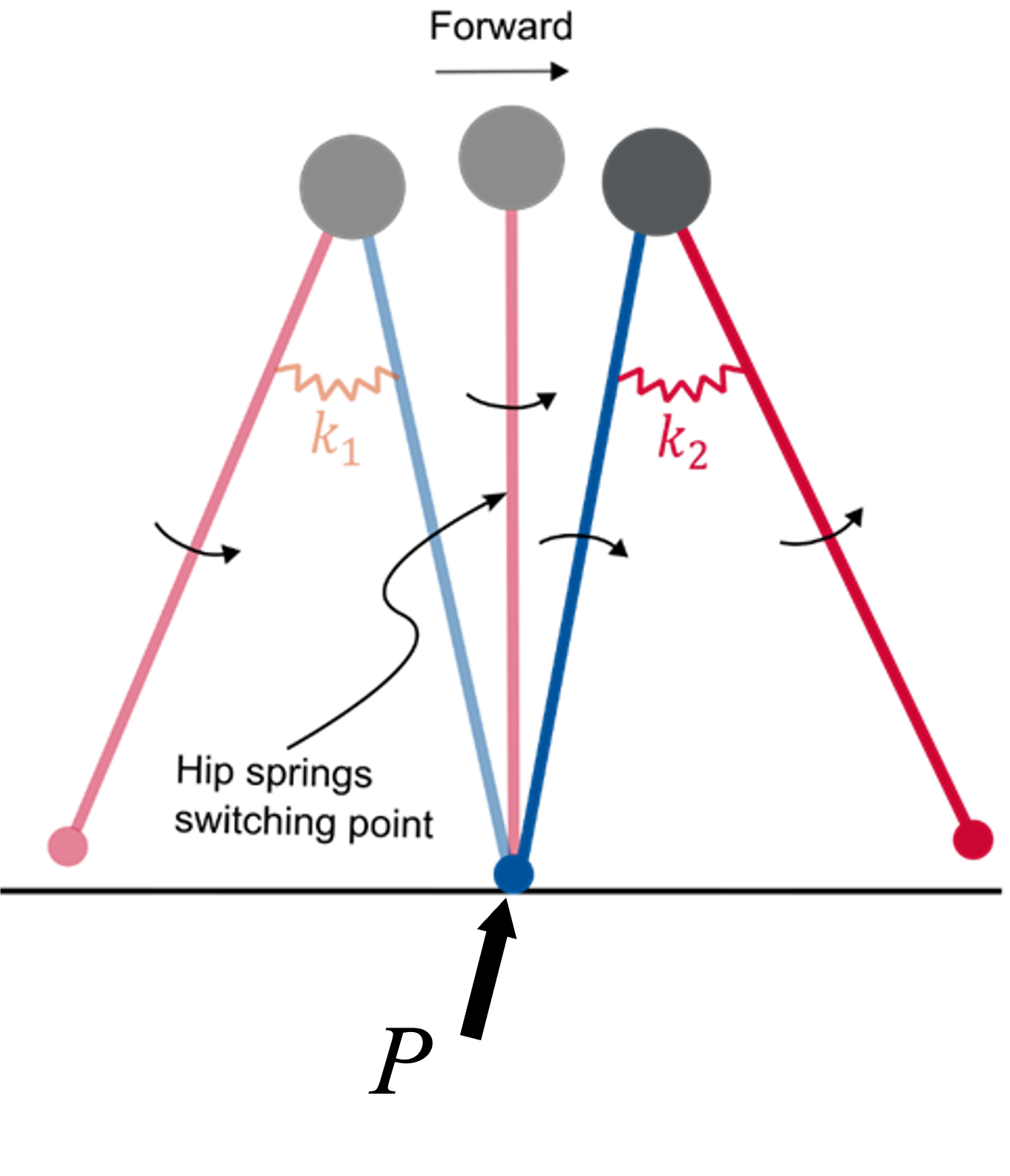
This model can walk with different step lengths and speeds [1,2]. It is actuated by a push off (P) and a two hip springs (k1 and k2), each active in one half of the swing. We discretized the space of possible step lengths and frequencies into a grid of step lengths and frequencies. We used optimization (Matlab’s fmincon) to find limit-cycle gaits at each grid point
Results
A wide range of gaits exist
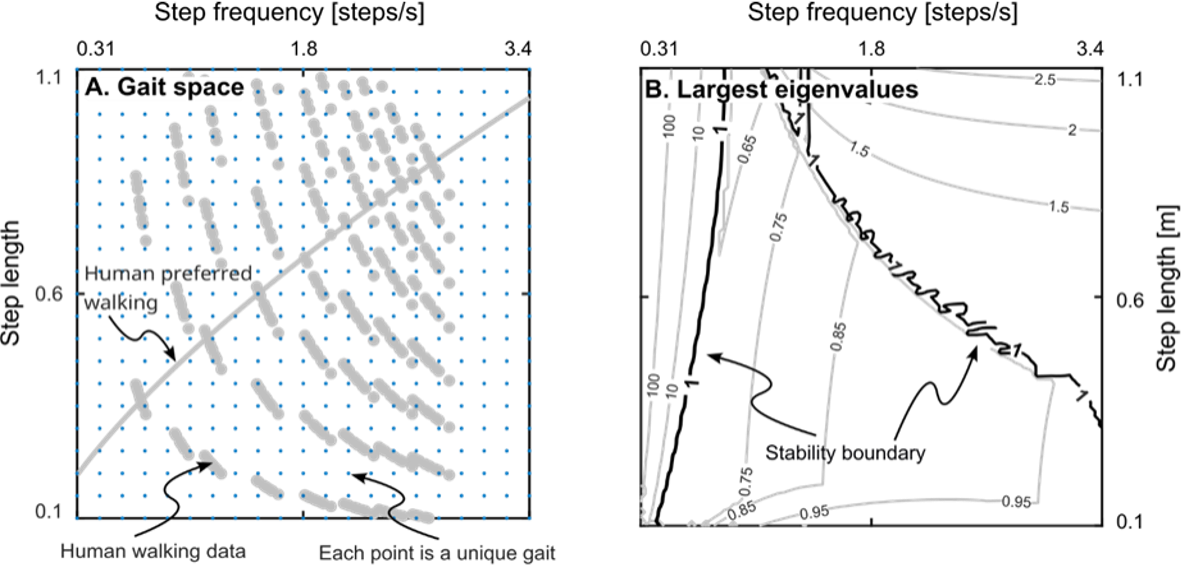
The walker can have a limit-cycle walks in a wide range of step lengths and speeds that goes beyond human walking.
Adaptation is possible with feedback control
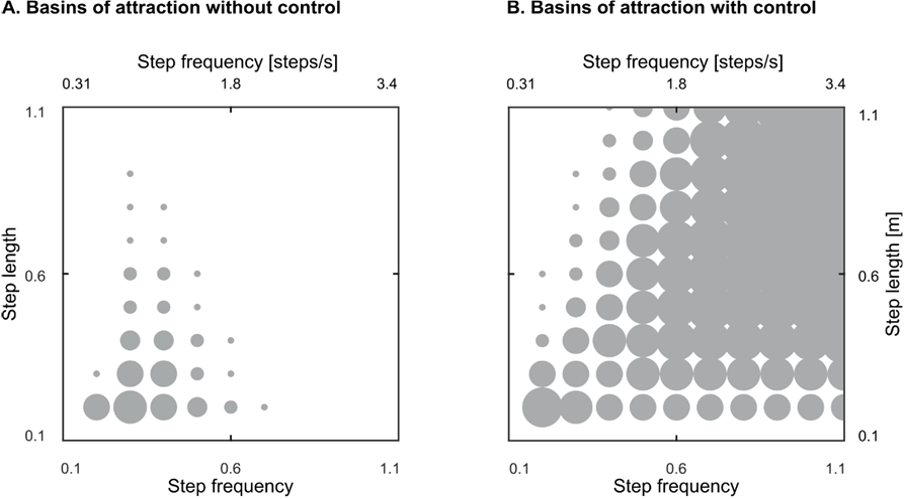
But some of the walks are passively unstable and and therefore unable to adapt to target gaits without active control. Thus active feedback control of the walker is needed. We used pole placement to determine controller gains. The feedback controller increased basin of attraction for all gaits
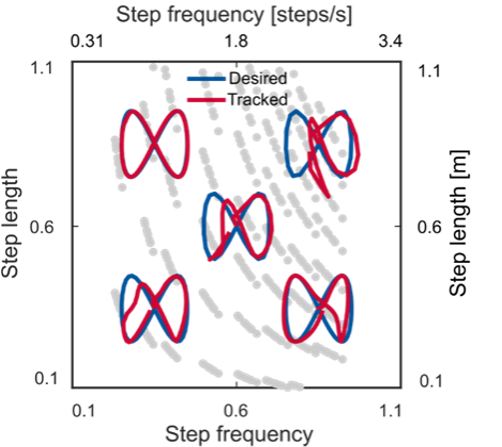
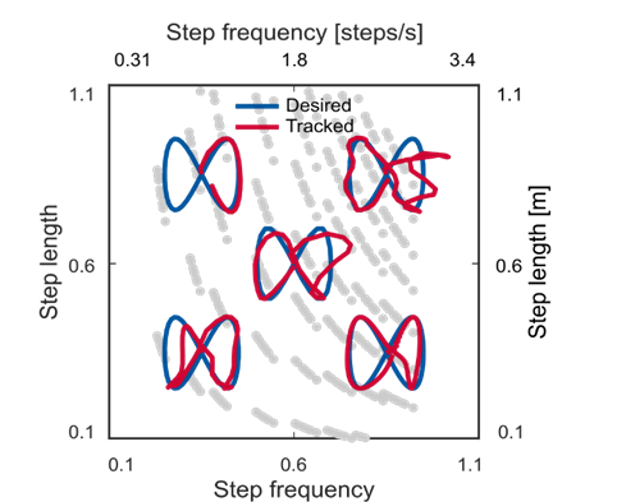
The general control policy can track sine paths in different regions of the gait space demonstrating successful adaptation
Reinforcement learning improved adaptation
We used RL to further enhance the performance of the pre-trained neural network controller. We used deep deterministic policy gradient [3] with the actor being the pre-trained neural network and the critic being an untrained neural network with two hidden layers of size 256. We added noise to the actions for local exploration. The average reward improved by 4.88±3.01% for all paths.
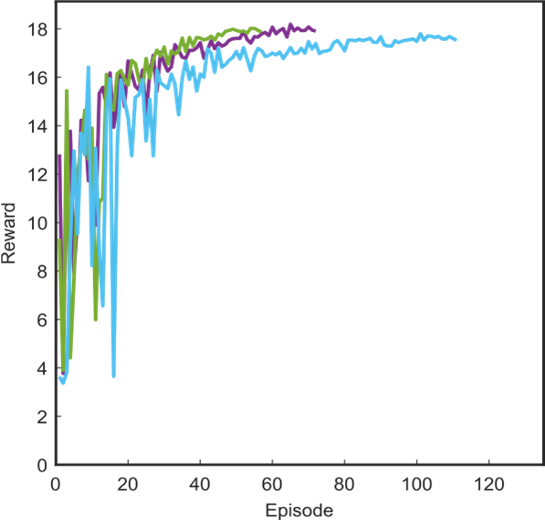
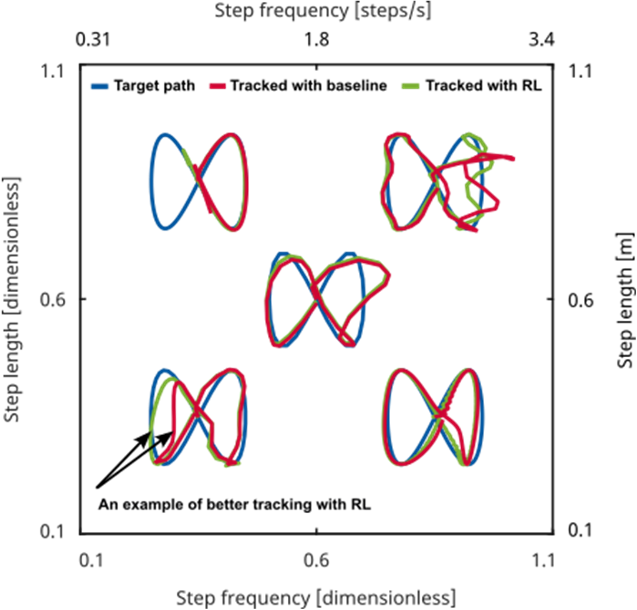
RL improved the pre-trained policy by tracking the target paths more closely. The RL training improved adaptation rate by reducing the minimum number of steps required to complete the paths. The RL training in one task generalized to another
A neural network control policy for adaptation
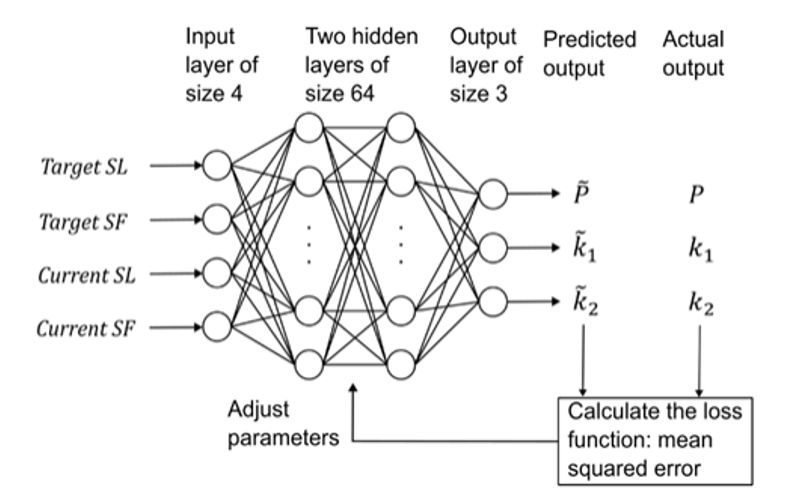
We used the algorithmic general control policy to train a compact neural network controller. We trained the neural network on a sample of 500,000 input/output pairs to serve as the baseline. The neural network control policy archives identical performance in adaptation compared to the algorithmic control policy
Discussion and Conclusions
Achieving better performance in regions with long step length and slow step frequency (top left). Adaptation in gaits with long step length and slow step frequency remains a challenge
Future Directions
- Using RL in a hierarchical design to explore energy-optimal walking
- Understanding principles of energy optimal adaptations
- Accelerate energy-optimal gait adaptation
References and Funders
- Garcia et al. J Biomech Eng 120, 281-88, 1998
- Kuo. J Biomech Eng 123, 264-69, 2001
- Lillicrap et al. ICLR, Puerto Rico, 2016
